2-Wire vs 4-Wire Smoke and Heat Detector: What’s The Real Wiring Difference?
Ever picked the wrong wiring type and hit installation headaches?
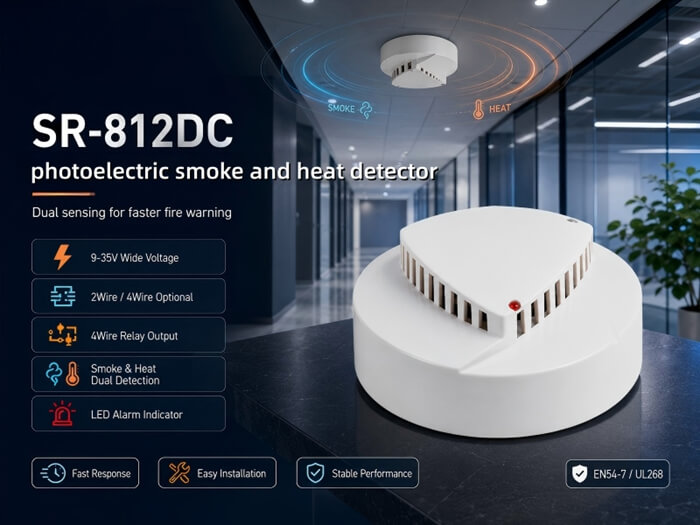
If you source hardwired fire detectors for installers, building contractors or local fire safety retailers, you have definitely run into this messy situation. Your customer orders a smoke and heat combined detector, the technician shows up on site, wires everything up, and then the fire panel refuses to read the unit correctly. No alarm signal, no fault feedback, wasted hours on the job. Most of the time, this problem does not come from defective hardware. It comes from mixing up 2-wire and 4-wire wiring setups. You might ask: they look almost identical on the product shelf, right? Both are ceiling-mounted photoelectric smoke heat detectors, both work within DC 9–35V wide voltage range. But the way they talk to your conventional fire alarm control panel sets them worlds apart. Today we break this down, using our Sumring SR-812DC dual-sensing detector as our example. Sumring has manufactured fire safety devices in China for more than 15 years, with products tested to EN54-7, UL539 and GB4715 standards. Our customers span installers and wholesale buyers across Europe, Southeast Asia and Australia, so we know exactly what pain points you run into when ordering wired detectors.
Let’s start simple: How does the 2-wire connection work?
The 2-wire setup uses just two single cables: L+ (loop positive) and L- (loop negative). Power supply and alarm signal share this same loop circuit. There is no separate relay wire here. That is the core rule you need to remember. Power feeds the detector through the two loop lines. When smoke or heat hits the alarm threshold (57°C for heat trigger on SR-812DC), the detector changes its current draw on that same loop, and the fire control panel picks up that shift as an alarm event. Do you know the upside here? Fewer cables to pull through wall conduits. Installation crews finish runs faster, less material cost for wiring, and less clutter inside ceiling cavities. This works beautifully for small office zones, retail shops, or renovation projects where existing cable runs only have two conductors available. There is a catch though. Your conventional fire panel must support 2-wire detector zones. Older, basic panels built only for 4-wire devices will not communicate properly with a 2-wire detector, no matter how carefully your tech connects the terminals. Our SR-812DC 2-wire version also uses non-polar input for the loop. That is a handy detail for field installers; they do not need to stress if they flip positive and negative by mistake. The infrared photoelectric sensor, MCU chip and anti-RFI shield inside keep running steady, with much fewer false triggers from fluorescent lights or nearby radio equipment.
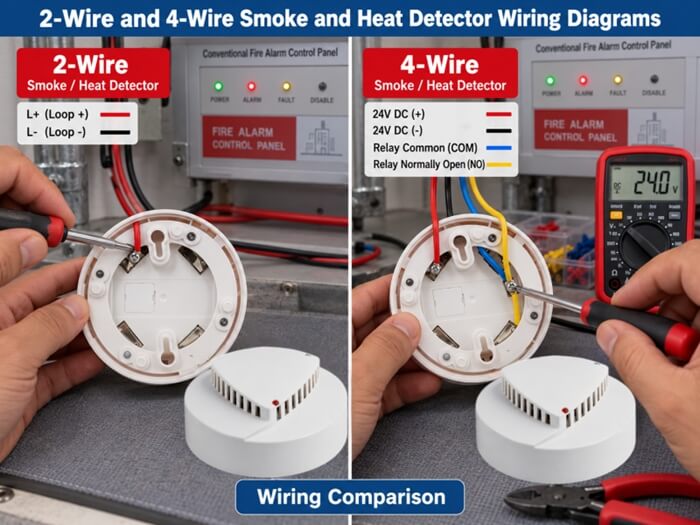
Now the 4-wire wiring setup: Separate power, separate relay signal The 4-wire model splits the job into two independent pairs of wires. One pair carries the 24V DC power feed (24V DC positive and negative). The second pair runs to the built-in relay: Relay Common (COM) and Relay Normally Open (NO). Power stays separate from alarm signalling. When the detector senses smoke or reaches 57°C heat threshold, the relay contact closes, and it sends a dry contact signal straight to the fire alarm panel. This separation gives installers and system designers more flexibility. Want to hook the detector up to auxiliary devices? Think sounders, strobe lights, or secondary monitoring boards. The relay output can trigger those extra devices directly. This is the reason many large commercial sites, warehouses and school buildings lean toward 4-wire detectors. It offers clearer signal supervision. The power circuit and alarm circuit do not interfere with each other. It does demand more wiring labour, of course. Your team must pull four conductors instead of two, label each wire clearly, and double check relay terminal positions before power-up. It adds a little more time per device, but the reliability pays off for high-risk commercial spaces. Just look at our wiring diagram for SR-812DC. The 4-wire terminals are clearly marked, so technicians can match red, black, blue and yellow wires without guessing. The detector still keeps all the same core hardware: dust and moth-proof optical chamber, stainless steel internal shield for RFI resistance, and bright LED alarm indicator for on-site visual check.
Quick side-by-side look at key practical differences
- Circuit sharing: 2-wire shares power + alarm signal on the same two lines; 4-wire keeps power and relay signal fully separated.
- Panel match: 2-wire requires a 2-wire capable conventional panel. 4-wire works with nearly all older conventional panels that accept dry relay contacts.
- Auxiliary triggers: 4-wire relay output supports external devices; standard 2-wire loop cannot tap into extra relays.
- Installation speed: 2-wire cuts wiring time and cable cost; 4-wire takes longer to run and terminate.
- Best fit: 2-wire suits small zones, retrofits with limited cable space; 4-wire suits commercial buildings and systems needing auxiliary alarm outputs.
Do not make the easy mistake of thinking “2-wire is better” or “4-wire is always safer”. The right pick depends fully on the fire panel your end customer already has installed. We have seen buyers place bulk 2-wire orders, only to discover their client’s existing panel cannot read 2-wire zones. That means returns, rescheduling install work, and unhappy end users. That is the kind of headache we help our wholesale customers avoid every week.
What stays the same between both wiring versions?
This part often slips past new buyers. The sensing core of the SR-812DC does not change, whether you select 2-wire or 4-wire variant. Both use infrared photoelectric smoke sensing paired with heat detection. That dual sensing design cuts false alarms that single-sensor units often get from cooking vapour or light dust. The MCU chip filters noise, and the sealed sensing chamber blocks light interference and insect dust. Both run stable from DC 9V up to 35V wide voltage input. Static current sits low at 20uA, which puts very light load on the zone circuit. Both mount flush on ceilings, and both activate the red LED light to mark an active alarm. They carry identical certification marks: EN54-7, UL539 and GB4715. So the safety compliance you need for tender documents and inspection reports works the same either way. The wiring option only changes how the detector communicates with the control panel. It does not change fire detection sensitivity or reliability. That is a key point to pass along to your installation partners.
Things to check before you place your bulk order Before you confirm an order for hardwired smoke heat detectors, get three simple details from your installer client.
First: What exact model of conventional fire alarm control panel will these detectors connect to? Ask if it supports 2-wire zone circuits, or only dry contact relay inputs.
Second: Will the system need to trigger external sounders, strobes or remote indicators from each detector? If yes, the 4-wire relay output will be the right call.
Third: What existing cable runs are already in the walls? If only two conductors are present, 4-wire detectors cannot work without running new cables.
These three checks stop costly mix-ups before they happen. Our sales team at Sumring runs through these questions with every bulk buyer, because we know how expensive site rework can get.
FAQ
- Can I mix 2-wire and 4-wire smoke heat detectors on the same fire panel zone? No. They use different signalling logic. Mixing them will cause fault readings or failed alarm reporting. Keep one wiring type per zone.
- Does SR-812DC 2-wire version have relay output? No. Relay output is exclusive to the 4-wire variant of SR-812DC.
- Is 4-wire smoke heat detector always compatible with every conventional fire panel? Most conventional panels support dry relay contact input for 4-wire detectors, but you still need to confirm the panel accepts the voltage range DC9-35V.
- Which wiring choice produces fewer false alarms? False alarm performance ties to the sensor and MCU filter, not wiring type. Both SR-812DC variants share the same dual-sensing anti-false alarm hardware.
- Can I swap a 2-wire detector directly for a 4-wire one on an existing 2-cable run? You cannot, because 4-wire needs a second pair of wires for the relay contact. New cable runs will be required.
You now know how to tell 2-wire and 4-wire smoke heat detectors apart, and how to guide your clients to the correct wiring variant. If you want samples of Sumring SR-812DC dual photoelectric smoke and heat detector for your install team to test both wiring configurations, reach out to our sales team. We supply certified units for wholesale buyers, with clear wiring diagrams and technical support ready for your projects.
Latest posts
-
 What Is a Flame Retardant Cable and Why Does It Matter?
Do you like ?0
Read more -
 Double Sensor Smoke Detector: Benefits for Commercial & Residential Fire Safety
Do you like ?0
Read more -
 Sumring at Canton Fair: Fire Safety & Gas Alarm Solutions For Global Buyers
Do you like ?0
Read more -
 How Our Factory Testing Guarantees Reliable Fire Safety Alarms
Do you like ?0
Read more -
 433MHz Wireless Smoke & Heat Detector: Why This Alarm Is a Smart Pick for Buyers
Do you like ?0
Read more -
 Queensland 2027 Smoke Alarm Mandate: What Fire Safety Buyers Must Know
Do you like ?0
Read more
Search
Hot Product