Are Independent Smoke Detector Common Abroad? A Global Guide to Home Fire Safety
If you are planning to live, study, or travel abroad, you might notice a small, round device on the ceiling of almost every room. This is an independent smoke detector. But just how common are they really?
The short answer is: extremely common. In many developed countries, installing an independent smoke detector is not just a safety recommendation—it is the law.
How Common Are Smoke Detectors in Different Countries?
In North America and Europe, the penetration rate of smoke detectors is among the highest in the world. Governments and fire departments have spent decades educating the public and enforcing strict building codes.
- The United States: The US is a global leader in fire safety. According to the National Fire Protection Association (NFPA), approximately 99% of American homes have at least one smoke alarm. It is mandatory for both new constructions and existing homes.
- Germany: In Germany, fire safety is taken very seriously. Laws require smoke detectors in all bedrooms, children's rooms, and hallways that serve as escape routes. Over 95% of German households are equipped with these life-saving devices.
- The United Kingdom & France: Since 2015, it has been a legal requirement in England for all residential properties to have smoke alarms on every storey. Similarly, France mandates that every home must have at least one certified smoke detector.
Why Are Independent Smoke Detectors So Popular?
You might wonder why the "independent" type is preferred over complex, wired systems in residential settings. An independent smoke detector (also known as a standalone smoke alarm) operates on its own. It does not need to be connected to a central fire control panel or a complex wiring system.
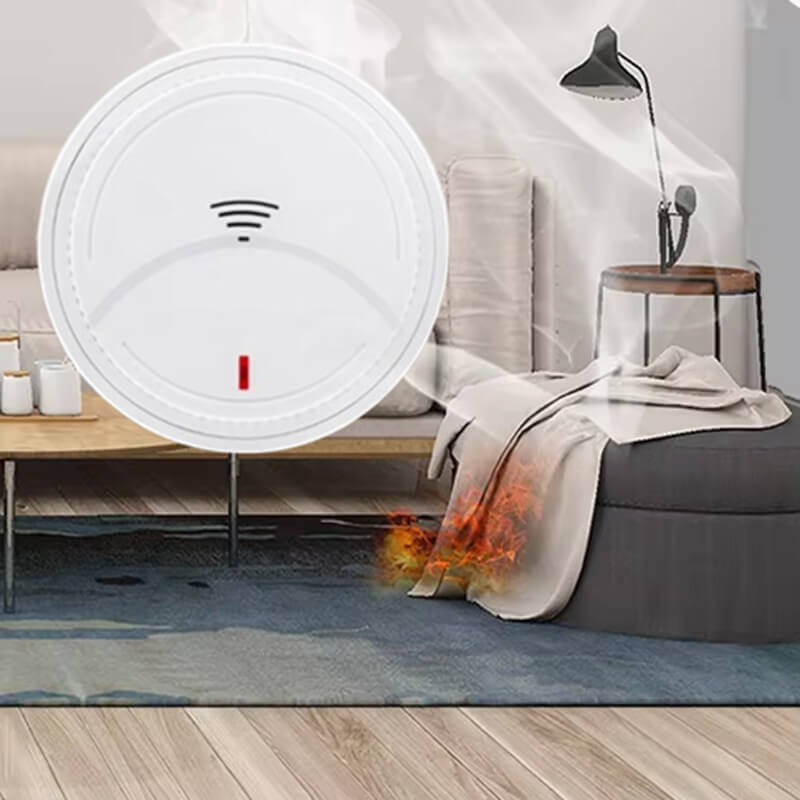
Key benefits include:
- Easy Installation: They are usually battery-operated and can be mounted on a ceiling with just a drill or strong adhesive.
- Cost-Effective: They are affordable, making it easy for homeowners to achieve the necessary installation density.
- Reliability: Even if the main power in the house goes out, a battery-powered independent detector keeps working.
Understanding Installation Density: Where to Put Them?
"Installation density" refers to how many detectors you need and where to place them to ensure maximum safety. Foreign fire safety standards are very specific about this.
- The "Every Room" Rule: In many Western countries, the standard is to install a detector in every bedroom, every hallway, and on every floor (including the basement).
- The 7-Meter Rule: For general coverage, a common rule of thumb in fire safety engineering (often cited in international standards) is that a single detector can cover an area of roughly 49 to 60 square meters (with a spacing of about 7 meters between units). However, for homes, the "room-by-room" approach is safer.
- Avoid False Alarms: While density is important, placement matters more. Detectors should not be installed in kitchens (where cooking smoke triggers false alarms) or bathrooms (where steam interferes with sensors). They should be placed on the ceiling, at least 50cm away from walls or light fixtures.
The Future: Smart and Connected Detectors
While the traditional independent smoke detector is standard, the market is rapidly evolving. The latest trend in the US and Europe is the Smart Independent Smoke Detector.
These devices offer the same easy installation as traditional ones but add modern features:
- Mobile Alerts: Send a notification to your phone if smoke is detected while you are away.
- Voice Alerts: Instead of just beeping, they can shout "Fire in the Kitchen!" to help you locate the danger.
- Interconnectivity: If one detector senses smoke, it can wirelessly trigger all other detectors in the house to sound the alarm simultaneously.
Conclusion
To answer the question: Yes, independent smoke detectors are ubiquitous abroad. They are a fundamental part of modern housing infrastructure in the US and Europe. Whether you are a landlord looking to comply with regulations or a homeowner wanting to protect your family, installing high-quality independent smoke detectors is the first and most important step in fire safety.
Latest posts
-
Can Standalone Smoke Detectors Repel Mosquitoes? (2026 Guide)
Do you like ?0
Read more -
 Application and Importance of Standalone Smoke Detectors in Rural Families
Do you like ?0
Read more -
 Why a Combination Smoke and Carbon Monoxide Alarm Is Essential (With Real Exampl
Do you like ?0
Read more -
 The Night a Combined Carbon Monoxide & Smoke Detector Alarm Saved Sarah’s Family
Do you like ?0
Read more -
 Smoke Detector or Carbon Monoxide Detector: Which is Better for Fire Safety?
Do you like ?0
Read more -
 Carbon Monoxide Detector vs Smoke Alarm: Key Differences for Home Safety
Do you like ?0
Read more
Search
Hot Product