Protective Cover SR‑A08‑PS: Real Saudi Arabia OEM Custom Project From Sumring
You know how tricky custom fire hardware orders can be for Middle East markets, right? Many importers reach out to fire alarm manufacturers expecting simple off‑the‑shelf parts, only to run into roadblocks. Local market labeling rules, special dimension needs, anti‑tamper requirements, and regional language printing can quickly turn a straightforward purchase into a real headache. This is exactly what happened with one of our long‑term partners from Saudi Arabia, when they came to Sumring with a special request for manual call point protective covers, model SR‑A08‑PS.
Sumring, based in Shenzhen China, has operated as a fire security hardware factory since 2014. Over more than 15 years, our team has shipped fire alarm components to more than 40 countries across Europe, Africa, Asia and the Middle East. We hold certifications including EN, UL, CE and RoHS, and complete ISO9001 management standards inside our facility. We work alongside over 600 global partners, and cooperate with 30 well‑known brands to deliver site‑specific fire protection hardware solutions. When this Saudi client got in touch, they already worked on dozens of commercial building and warehouse projects back home. They did not want standard protective covers stocked for general markets. They needed something built strictly for Saudi local job‑site conditions.
What Exactly Did The Saudi Customer Need For SR‑A08‑PS?
Let me break down their actual requirements, so you can picture the project clearly.
First off, dimension upgrade. Standard manual call point covers sit with a low base. For many wall‑mounted manual pull stations in Saudi construction sites, extra space behind the cover was needed for pre‑installed wiring. The customer asked us to raise the base mold all the way to 50 mm. That extra clearance makes installation far smoother for technicians on‑site; no more squeezing thick wiring into tiny gaps. Have you ever seen installers fight to close protective housings because internal cables take up too much room? This raised‑base design fixes that very common pain point.
Second requirement: dual‑language custom surface printing. Every cover had to carry both English and local Arabic text for ODM / OEM custom service, targeting projects inside the Kingdom of Saudi Arabia. Generic stock covers only print English fire safety words. On Saudi commercial sites, local inspectors expect visible Arabic markings on fire safety hardware. If your hardware lacks region‑required language labels, your whole project can face inspection hold‑ups. That is a risk no contractor wants to carry.
Third, reserved drilling position on the top cover. The client’s field technicians sometimes fit external alarm accessories, such as auxiliary strobe lights. They needed pre‑defined 3.500 mm drilling holes on the top shell. This lets installers run extra wiring without damaging the plastic housing with messy hand‑drilling out on site.
Fourth, anti‑loss red tether accessory. Once site crews remove the transparent protective cover for testing or maintenance, loose plastic shells often go missing on busy construction sites. The built‑in red tether physically fastens the cover to the main unit. Technicians can lift the cover marked “LIFT HERE”, work on the manual call point, and the cover will not drop or disappear across the job site.
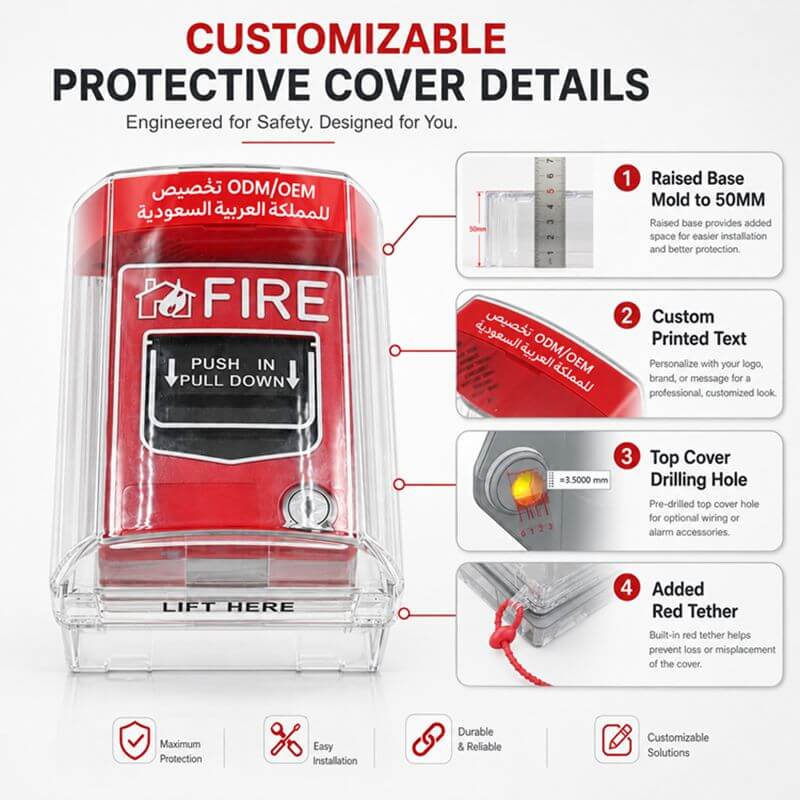
The customer also stressed material toughness. These covers sit in public corridors, retail spaces and warehouse access zones. They take knocks from carts, staff and building visitors. Thin brittle plastic will crack quickly. Our SR‑A08‑PS protective cover uses heavy‑duty transparent plastic, built for maximum physical protection against bumps and accidental impacts.
How Sumring Handled This Saudi Custom Project Step‑by‑Step
A lot of factories will say “yes we can do OEM” at first contact, then push back once they hear about mold modification and custom printing. Our workflow moved through four clear stages for this SR‑A08‑PS batch.
We kicked things off with full requirement confirmation. Our sales and engineering team reviewed every point the Saudi partner listed: 50 mm raised base mold modification, exact Arabic‑English text copy, top‑cover drill hole specification, red tether attachment, and impact‑resistant material grade. We double‑checked the Arabic print text to avoid character misprints — wrong Arabic characters would render the whole batch unusable for Saudi inspection standards.
Next, prototype sample production. We adjusted our base mold to hit the 50 mm height, printed the dual‑language markings, fitted the red tether part, and produced physical pre‑production samples. We sent photos and sample shipping references over to the Saudi buyer. They checked dimensions, readability of the Arabic print, tether function and drilling hole position. They gave small feedback on text placement, and our engineering team adjusted before mass manufacturing started.
Then mass production and quality spot‑checks. Our factory runs under ISO9001 rules. Every SR‑A08‑PS unit from this order went through visual checks: print clarity, tether connection strength, shell fit, base dimension measurement. Bad units get filtered out before packing. Keep in mind: custom molded parts always carry small risks of printing defects or mold tolerance drift. Spot testing keeps those issues out of your final shipment.
Final step: packing and logistics coordination. We packed custom protective covers with shock‑resistant inner packaging for long‑sea shipping to Saudi Arabia. Our team shared all batch documentation, product photos and certification copies for the customer’s local import clearance.
What Real‑World Benefits Did This Custom SR‑A08‑PS Bring To The End‑User Projects?
So why go through custom mold work instead of buying cheap off‑the‑shelf protective covers? Let us look at real outcomes from this Saudi project.
- Smooth local safety inspections: Dual‑language Arabic‑English printed text satisfied local building code reviewers. No delays because of missing regional language markings. Many overseas importers overlook local label rules until cargo lands at port, and that mistake costs weeks of project time.
- Faster field installation: The 50 mm raised base gave installers enough internal room for existing wall wiring. Technicians finished mounting each manual call point cover in far less time. Job‑site labour hours drop, and project schedules stay on track.
- Less hardware loss on busy sites: The built‑in red tether stops transparent protective covers from getting misplaced during maintenance or fire‑system commissioning. Replacing lost site hardware adds unexpected extra costs for contractors. This simple small part cuts those avoidable expenses.
- Flexible accessory expansion: Pre‑reserved top‑cover drill holes let field teams hook up auxiliary alarm accessories whenever project plans demand it. They do not need to buy separate modified housings later.
You might wonder: is custom OEM work only for huge bulk orders? That is a misconception many buyers hold. While large batches lower per‑unit mold amortization cost, Sumring also supports reasonable MOQ for ODM/OEM fire‑hardware customizations for qualified project partners across Middle East markets.
Things Fire Alarm Importers Should Think About Before Placing Custom Cover Orders
Drawing experience from this Saudi Arabia SR‑A08‑PS case, here are practical points every procurement person should weigh before launching custom protective‑cover projects.
‑ Confirm local market labeling requirements first. Some Middle‑East regions demand native‑language text printed directly on fire‑safety hardware. Stick‑on paper labels will often fail inspection rules; permanent shell printing is required. ‑ Measure your existing manual call point body and behind‑wall wiring depth. A standard‑height protective cover may not fit your on‑site wiring layout. Raised‑base options like SR‑A08‑PS solve that fit problem. ‑ Think about site working conditions. Busy construction and warehouse locations see lots of physical bumping. Anti‑loss accessories such as red tethers add real long‑term value you cannot see in product catalog pictures. ‑ Ask your supplier for pre‑production physical samples. Never approve mass production only from render images. Real samples catch printing mistakes, dimension gaps and assembly issues long before full‑batch shipping.
If you source fire alarm hardware for Middle‑East commercial builds, warehouse projects or retail developments, you will run into these exact same custom‑fit challenges sooner or later. Not every fire‑hardware supplier understands regional Saudi Arabia code expectations for manual call point accessories.
Sumring is a Shenzhen‑based fire‑security manufacturer founded in 2014. Our catalog covers manual call point covers, full fire alarm systems, gas detectors, smoke detectors, installation accessories and horn shell parts. We complete ODM, OEM and OBM service for global buyers. We have delivered custom printed manual call point protective covers for multiple Middle‑East project partners. If you are searching for dependable custom solutions for manual call point protective housings like SR‑A08‑PS for your upcoming Saudi or Gulf region projects, reach out to our team. Send your dimension requirements, printing text and project details to info@sumring.com, or visit SUMRING to check our full product portfolio. Our engineering team can walk you through sample, mold and lead‑time information for your next custom order.
FAQ
Q1: What is SR‑A08‑PS manual call point protective cover used for?
A: SR‑A08‑PS is a transparent protective housing for fire manual pull‑station call points. It shields manual call points from accidental pressing, dust and physical impact in commercial buildings, warehouses and retail premises. It supports custom mold height, custom shell printing and anti‑loss tether accessory.
Q2: Can Sumring print Arabic local‑market text on manual call point protective covers for Saudi Arabia projects?
A: Yes. We support custom OEM printing for Arabic‑English dual‑language markings on SR‑A08‑PS and other protective‑cover models. We verify text content before sample production to meet local inspection requirements.
Q3: What is the advantage of the 50 mm raised‑base mold for manual call point protective covers?
A: The raised‑base mold creates extra inner space. Installers can accommodate thicker wall‑mount wiring behind manual call points, so they close the protective housing without forcing or damaging internal cables.
Q4: Does the SR‑A08‑PS protective cover support extra accessory wiring holes?
A: Yes. We can reserve pre‑set drilling holes on the top cover. This allows installers to run wiring for auxiliary alarm accessories such as strobe lights without destroying the plastic shell on‑site.
Q5: What certifications does Sumring fire‑alarm hardware hold?
A: Sumring fire security products carry EN, UL, CE and RoHS certification. Our factory runs under ISO9001 quality management system. We have over 15 years of manufacturing experience exporting fire alarm hardware to more than 40 countries worldwide.
Search
Hot Product