Real‑World Application Scenarios Requiring Reliable CO Protection,Carbon Monoxide Risks Exist In Far More Locations Than Most Buyers Expect
If you distribute globally, renovate properties, or purchase carbon monoxide and gas alarms in bulk for commercial projects, you have likely heard the same feedback repeatedly. “Our client’s site is not compatible with standard carbon monoxide detectors.” Or “Will this unit stand up to the special environmental conditions at my customer’s premises?” You know that frustrating experience well: large‑volume goods are shipped out, only to find the devices perform abnormally under real‑world site conditions.
Did you know carbon monoxide is not limited to one single building type? This colourless, odourless toxic gas can build up wherever fuel‑burning equipment operates. For that reason, a quality carbon monoxide alarm should not only work in ordinary residential bedrooms. It has to operate reliably across a wide range of real‑life environments. For purchasing managers, importers and hardware distributors, thorough knowledge of different application scenarios directly shapes every buying decision. Misjudge whether a device fits the site, and returns, customer complaints and compliance troubles will quickly follow.
Many new buyers only associate carbon monoxide alarms with private homes. While residential markets account for substantial demand, suitable applications stretch well beyond suburban houses. Think of rental apartments, hotel guest rooms, small retail shops, public housing units, remote vacation cabins, office pantries and bathing spaces. Each location brings real‑world challenges: fluctuating humidity, dust, wide temperature swings, high tenant turnover and difficult maintenance access. Not every carbon monoxide detector can handle all these operating conditions smoothly.
Residential Settings: More Than Just Standard Bedrooms
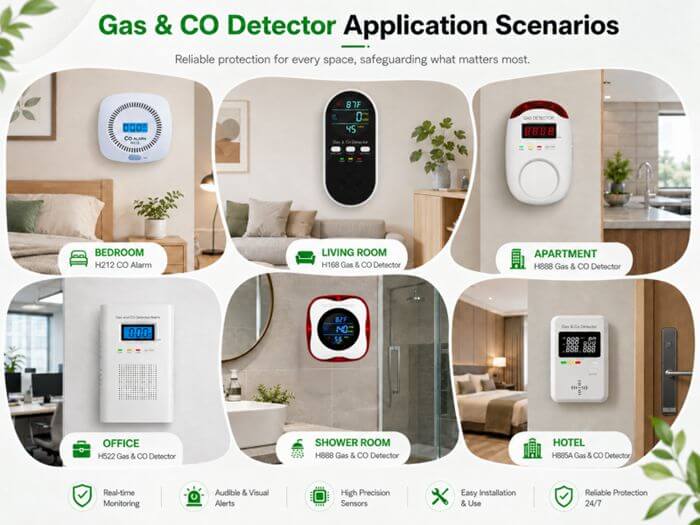
Let’s start with the most familiar residential applications. Bedrooms and living rooms are typical installation spots for carbon monoxide alarms. People sleep in these areas and would have no way to detect danger if carbon monoxide leaks overnight. Installed near heating units, gas fireplaces or wood‑burning stoves, the device delivers early warnings before gas concentrations reach harmful levels.
But what about short‑term rental apartments and holiday suites? These sites create tricky practical challenges. Guests change every few days; occupants are not property owners and will almost never press the test button on the alarm. Some guests even cut power to alarms simply to silence nuisance beeps. Have you received customer reports of rental‑property alarms being manually disabled by careless occupants? This situation happens in property markets all over the world. Alarms built for these environments need stable hardware, simple operation and housings that resist unauthorised tampering.
Public housing and multi‑unit residential buildings fall into this category too. Hundreds of separate dwellings are managed by one maintenance team. Service staff cannot visit every unit for monthly checks. Devices that run reliably with minimal routine checks greatly reduce workload for property crews. High humidity from cooking and bathing fills the air inside these buildings. Residential carbon monoxide alarms must withstand long‑term moist conditions without false alarms and without premature sensor degradation.
Commercial and Light‑Commercial Sites: Far Tougher Operating Environments
Residential use is one thing; commercial and light‑commercial premises are a completely different story. Do you supply safety hardware for small‑business customers? These locations push carbon monoxide detectors right to the performance limits of ordinary household units.
Take hotel guest rooms as an example. Hundreds of enclosed sleeping spaces sit within one building, with heating systems, water heaters and compact kitchenettes running around the clock. Guest adjustments to thermostats cause indoor temperatures to rise and fall, and steam from bathrooms drifts into sleeping areas. Alarms for these sites need to ignore normal water vapour yet still respond quickly to genuine carbon monoxide. Installers deploy devices across dozens or hundreds of rooms, so quick, straightforward mounting cuts overall project labour costs significantly.
Small retail stores and local service outlets represent another key market. Many occupy older buildings with ageing heating appliances and inconsistent ventilation. Windows stay closed in winter, so leaked carbon monoxide cannot disperse outdoors. Most small‑site operators work with limited maintenance budgets and have little time for frequent device servicing. Units you supply must deliver stable performance with very little human intervention.
What about office buildings? Most people assume offices barely face carbon monoxide hazards. Is that really true? Gas‑fired water heaters in pantries, generators in equipment rooms and zones connected to underground car parks can allow carbon monoxide to seep into work areas. Employees spend eight or more hours on‑site every day. Long‑term low‑level CO exposure brings headaches and fatigue, symptoms workers often write off as ordinary work‑related tiredness. A properly fitted carbon monoxide alarm catches this hidden safety risk before health issues emerge.
Tricky High‑Humidity Environments: Bathrooms, Shower Rooms and Utility Rooms
Many datasheets do not highlight this point enough: high‑moisture environments. Shower rooms, public washrooms and laundry utility spaces constantly generate steam and moisture. Low‑cost carbon monoxide alarms frequently fail in these conditions. Condensed moisture settles on sensor surfaces, triggering persistent false alarms and, over time, causing permanent sensor damage. End‑users annoyed by non‑stop beeping may disconnect the alarm or ignore warnings entirely, creating critical safety gaps.
Does that mean carbon monoxide alarms cannot be fitted in damp areas? Absolutely not. You simply need hardware engineered to resist high humidity and condensation damage. Units rated for up to 95 % RH non‑condensing can operate reliably inside bathrooms and utility rooms. They withstand steam exposure while remaining responsive to real carbon monoxide. Many first‑time importers fall into this trap: ordering standard indoor‑model units for damp shower‑room installations, then receiving waves of customer complaints.
Remote and Semi‑Outdoor Locations: High On‑Site Maintenance Costs
Now let’s cover scenarios most buyers overlook: mountain cabins, remote work sites and temporary shelters. These sites sit far from maintenance teams, so service visits consume considerable time and money. You cannot send technicians out every couple of months just to service safety alarms.
Fuel‑powered generators, space heaters and wood stoves are commonly used inside these enclosed spaces, creating significant carbon monoxide risk. Yet on‑site personnel may lack full safety awareness. Alarms intended for such locations require long‑life power supply, clear audible‑visual alerts and consistent sensor performance. Complex multi‑step menus serve no purpose here; simple, intuitive operation is essential.
What Broad Compatibility Means For You As A Global Buyer
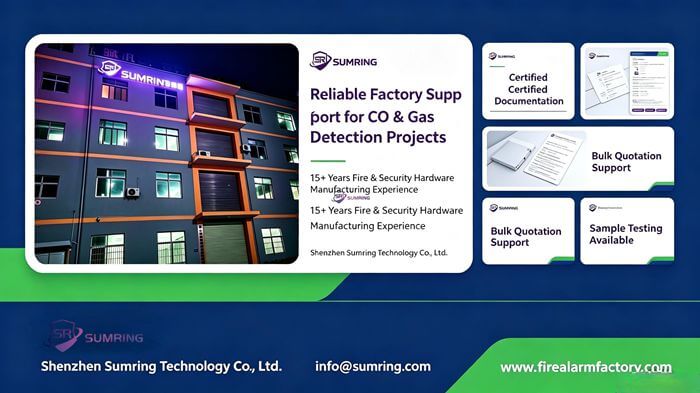
Shenzhen Sumring Technology boasts over 15 years of experience manufacturing fire and gas safety devices. Every year we communicate with hundreds of overseas buyers, and we keep seeing the same mistake. Buyers find one carbon monoxide alarm model and deploy that exact unit across every kind of site. This approach rarely yields good results.
A device that performs perfectly in dry urban apartments may deliver degraded performance when placed inside steamy public shower rooms or unheated remote cabins. For every project, select hardware against real‑world site conditions. Confirm operating‑temperature range, maximum humidity rating, sensor type, power‑supply scheme and anti‑tamper features before finalising bulk orders. Skip these checks and returns plus customer dissatisfaction become hard to avoid.
Fortunately you do not need to stock dozens of different SKUs to cover most market demands. Well‑designed combined carbon monoxide and gas detectors can satisfy multi‑family residences, hotel projects, small‑business premises and damp utility rooms with just a small product range. Our in‑house portfolio covers bedrooms, living rooms, apartments, offices, shower rooms and hotel premises, maintaining stable output under variable environmental conditions. Every unit completes full laboratory testing across its full rated operating envelope. The factory follows ISO 9001 quality‑management systems and holds global certifications including CE and RoHS, giving distribution partners confidence for cross‑border projects.
One important note: wide‑ranging compatibility does not mean unlimited installation flexibility. No carbon monoxide alarm should be mounted directly above combustion‑equipment exhaust outlets or where dripping water falls onto it continuously. Even premium hardware has installation boundaries. Share clear installation guidelines with fitters and end‑users, and you will prevent most foreseeable device failures.
FAQ
Q1: Can apartment‑spec carbon monoxide alarms also be fitted inside humid shower rooms?
A: Only models explicitly rated for high non‑condensing humidity are suitable for shower‑room use. Ordinary household carbon monoxide alarms are prone to steam‑driven false alarms and even sensor damage. Always verify humidity specifications before deployment in damp locations.
Q2: Which key parameters should I compare when purchasing carbon monoxide detectors for both residential and commercial projects?
A: Review operating‑temperature range, maximum relative‑humidity rating, sensor service life, power‑supply configuration, anti‑tamper design and complete certification documentation. These specifications determine real‑world performance across different sites.
Q3: Are hotel‑use carbon monoxide alarms designed differently from household versions?
A: Hotel‑oriented units need simple operation, tolerance to frequent humidity shifts and clear end‑of‑life warnings. Many hotel projects also require tamper‑resistant hardware to cope with high guest‑turnover cycles.
Q4: Can ordinary carbon monoxide alarms be installed in off‑grid remote cabins with limited maintenance access?
A: Yes, prioritise long‑life, wide‑temperature‑range models. Bear in mind that even well‑built units will experience shortened service life under extreme high‑ or low‑temperature conditions.
Q5: Why do some carbon monoxide detectors inside multi‑unit apartments trigger frequent false alarms?
A: False alarms mostly stem from hardware unsuited for high moisture from kitchens and bathrooms, poor mounting positions, or units that do not meet multi‑dwelling environmental requirements. Fit properly‑specified hardware and strictly follow official installation instructions to reduce these issues.
If you are sourcing carbon monoxide alarms or combined gas‑CO detectors for tenders, property projects and want units suited for diverse operating environments, feel free to reach out to Sumring. Our technical team can supply complete datasheets, certification documents, on‑site installation guidance and competitive bulk pricing. You may also request samples for real‑site testing to confirm suitability for your customers’ actual working conditions.
Latest posts
-
 Why You Need a Smoke and Carbon Monoxide Combo Detector in Your Home ?
Do you like ?0
Read more -
 Why a Combination Smoke and Carbon Monoxide Alarm Is Essential (With Real Exampl
Do you like ?0
Read more -
 The Night a Combined Carbon Monoxide & Smoke Detector Alarm Saved Sarah’s Family
Do you like ?0
Read more -
 The Silent Guardian: Why Every Home Needs a Carbon Monoxide Detector
Do you like ?0
Read more -
 Carbon Monoxide Detectors: Why They’re Non-Negotiable for Home Safety
Do you like ?0
Read more -
 The Night a Carbon Monoxide Detector Saved the Carter Family’s Lives
Do you like ?0
Read more
Search
Hot Product